When a tree has to come down — by disease, design, or necessity — it has to come down safely. Ropes, frictional devices, modern rigging. No guesswork, no drama.
Rigged & controlled
Some trees are beyond saving — disease, storm damage, planning constraints, or just outgrown the plot. We bring the tree down in one piece where we can, or section by section where we can't, with minimum disruption to what surrounds it.
Serving Brighton, Hove, Ringmer, Lewes, Seaford, Shoreham, Henfield, Worthing and all surrounding BN postcodes.
01 — Tree Felling
Whether a tree is unhealthy, diseased, incompatible with planning demands, or simply unwanted, we apply safe tree felling methods to remove it from its current location. If a tree is small enough — and site conditions allow — it is cleanly felled in one piece.
If not, we use modern rigging techniques with high-strength ropes, pulleys and frictional devices to lower sections in a controlled way, minimising disruption to nearby features. When trees must come down without ropes, we use mechanical dismantling techniques.
02 — Stump Removal
Once a tree is removed, the stump and its roots are next. Our stump grinding machines deal with the full set — eliminating the need for chemical growth preventatives and leaving soil that's ready to replant.
If you've inherited a stump from a previous tree, we can come back just for the grinding. No tree removal required.
Signs to watch for
A shortlist of the scenarios that bring customers to this service — if any of them look familiar, it's probably time for a conversation.
Full canopy die-back, suckering at the base, brittle major limbs. Dead trees are unpredictable in high wind, and fungal decay spreads fast. Removal is usually the sensible call.
Split unions, extensive root-plate movement after storms, decay columns visible at the base. When the structure is gone, the canopy becomes a countdown.
Advanced ash dieback, bleeding canker on horse chestnut, honey fungus at the roots, Dutch elm on a mature elm. At a certain stage, keeping the tree is just delaying the problem — and adding risk in the meantime.
Roots lifting patios, damaging foundations, or encroaching on drainage runs. Canopies growing into roofs or leaning toward the house. Felling is sometimes the only realistic fix.
Planning-approved removal for an extension, a new build, or landscape redesign. We work from felling plans and coordinate with your contractor's programme.
A leyland cypress planted as a hedge that became a row of 20-metre monoliths. A self-seeded sycamore taking the back garden. Some trees are better replaced with something proportionate to the space.
What to expect
From the first phone call to the last leaf cleared — the order of operations on a typical Branchwalkers job.
We come out, look at the tree, the ground, the structures and targets around it. We consider species, lean, crown distribution, escape routes — then recommend a felling method.
Back to you within 48 hours. We specify whether it's a whole-tree fell, a sectional dismantle, or a rigged take-down, plus crew, kit, traffic management if needed, and disposal — with a clear price.
TPO application if required. Conservation Area notification (six weeks) if applicable. Felling licence via the Forestry Commission if the volume crosses 5m³ in a calendar quarter. We handle all of this as part of the job.
Site set up with exclusion zones, signage, and traffic management if needed. Whole fells where space allows; sectional takedowns with rigged lowering where it doesn't. Nothing dropped onto what it shouldn't hit.
Stump ground out to root-plate, hole backfilled with arisings or left ready to reseed. All wood chipped and removed. Site raked, swept, left clean — or timber stacked for you if you want firewood.
On the ground
Rigged dismantling and clean stump removal — here's a recent Sussex felling job, canopy to chip. Click any image to enlarge.
In Sussex specifically
Most Sussex felling calls come down to one of three drivers: ash dieback — now across almost every woodland, hedgerow and garden boundary; storm damage — the South Coast takes the brunt of Atlantic weather through winter, and October to February call-outs spike accordingly; and historic over-planting — leylandii hedges planted in the 1970s that became 20-metre monoliths, or garden-centre Atlas cedars planted too close to Victorian terraces. Conservation Area density is high in central Brighton (Regency, Kemp Town, Montpelier, West Hill), Hove (Brunswick, Cliftonville), and Lewes Old Town — which means a six-week notice period on most residential fells, all handled by us. Felling volumes over 5m³ in a rolling quarter require a Forestry Commission felling licence; we've processed dozens and factor them into the timeline on quoting.
Frequently asked
Straight answers to the questions that come up most often on site visits. Not here? Pick up the phone — we're happy to get into the detail.
You need consent if the tree has a Tree Preservation Order, or if your property sits in a Conservation Area (six-week notice to the council). Over a certain volume — 5m³ in a rolling quarter — you'll also need a Forestry Commission felling licence. We check all three for every quote and handle whatever paperwork applies.
A licence issued by the Forestry Commission required for felling over 5 cubic metres of timber in a calendar quarter, or over 2m³ if any is sold. Most single-tree domestic jobs stay under the threshold. Larger clearances, woodland work, and multi-tree jobs usually trigger it. We calculate the volume and apply if needed.
Yes, if you want. We stump-grind as a follow-on or a separate visit. Grinding takes the stump and primary roots down below ground level so you can reseed, returf, or pave over. We can leave it for a wildlife habitat if that suits better.
Two options. Either we chip and remove all arisings — everything is recycled for biomass, nothing to landfill — or we stack the usable timber for you as firewood (seasoned or fresh; you do the drying). Say which you prefer at quote stage.
Yes — that's where sectional dismantling comes in. Climber ascends, limbs and trunk sections are cut and lowered on ropes through friction devices, piece by piece. Takes longer than a whole-tree fell but doesn't need the ground-space. We do this routinely in Brighton, Hove and Lewes terraces.
For non-urgent work, typically two to four weeks from quote acceptance. For genuine emergency call-outs — storm damage, immediate hazard — we try to be on site the same day or next working day.
Straight felling drops the whole tree in one controlled movement, cutting a hinge at the base and aiming it into a clear space. Sectional dismantling takes the tree down in pieces with a climber in the canopy, lowering each piece on ropes. We use whichever is safer for the site.
We use ground-protection mats under rigging points, keep machinery on laid tracks, and rake / sweep everything at the end. Some bruising to lawn is occasionally unavoidable in wet conditions — it grows back within a couple of weeks. We flag anything we're worried about before we start.
A straightforward single-tree job with good access: half a day. A sectional dismantle of a mature canopy in a tight garden: one to two days. Multi-tree clearances: we'd quote you a programme. Stump grinding adds a few hours per stump depending on size.
Adjacent services
Less drastic shaping when you want the tree to stay, just smaller or lighter.
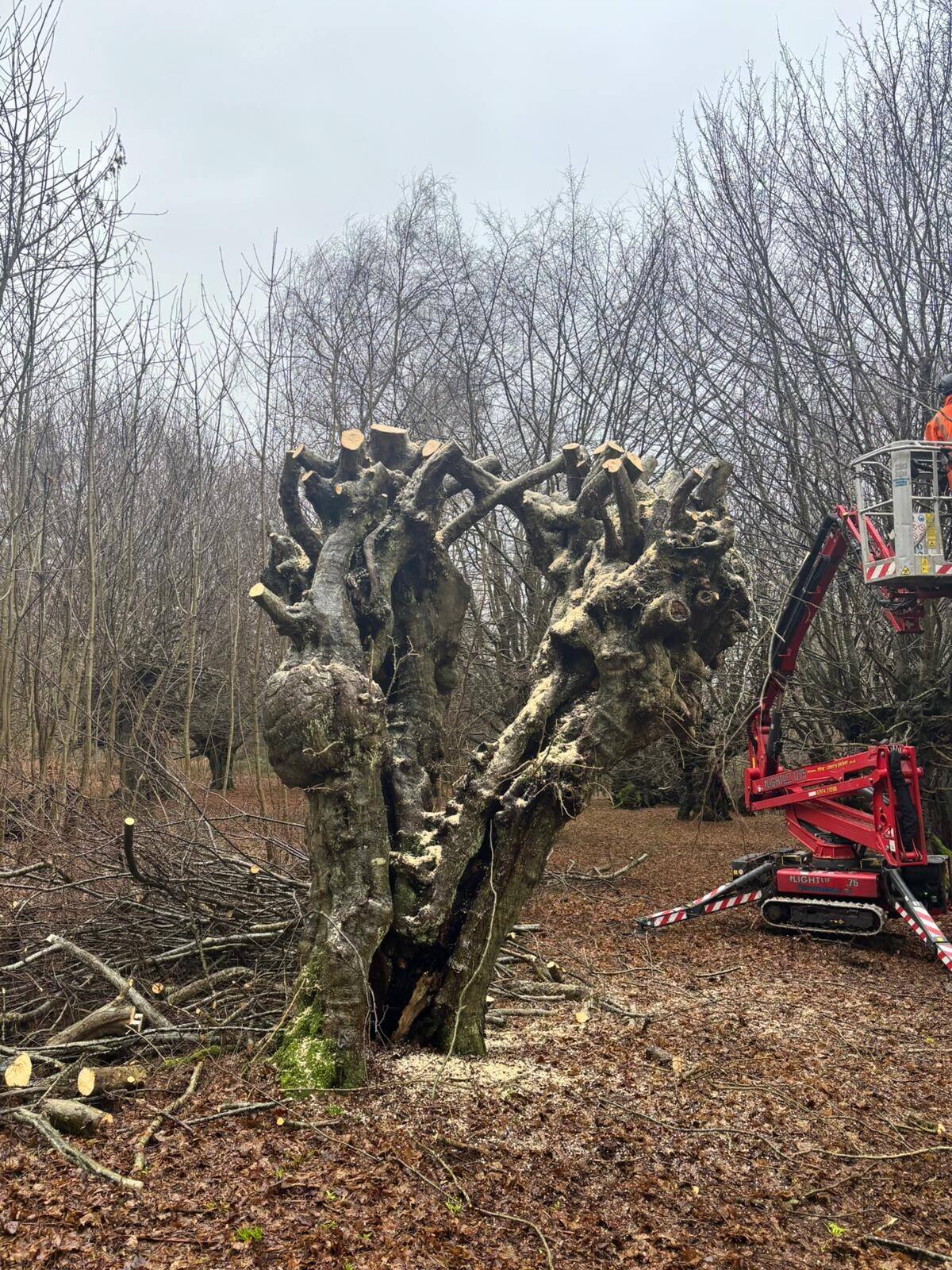
Heavy reduction for confined spaces, plus clean deadwood removal from established canopies.
Strimming, mulching, undergrowth — clearing a site ready for what's next.
Verified feedback
Independently verified reviews on Checkatrade — filter by the kind of work to see how Branchwalkers handled it before.
Read client reviews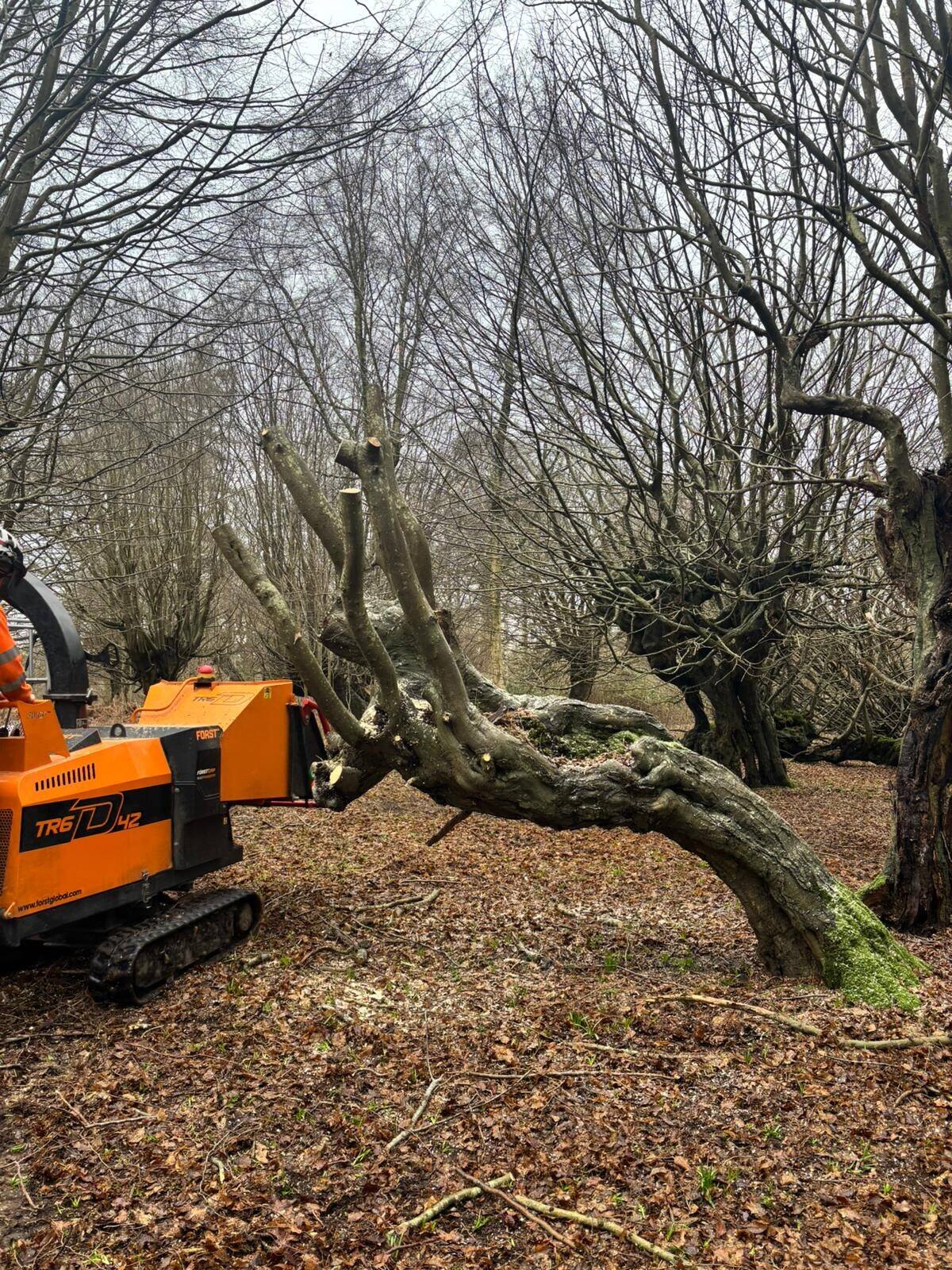
Book a free site visit. We'll assess the tree, explain the felling method, and quote transparently — no surprises.
0800 567 7433Or request a quote online — replies within 48 hours